Faithful Conference 2025

A Reformed Guide to Christian Government

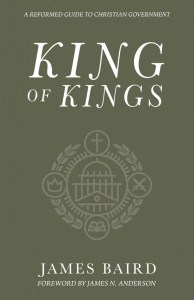
King of KingsUnless you’ve been on a mission to Mars the last few years, you’ll be aware of the lively public debate over the relationship between religion and civil government, the proper roles of church and state, the place of the Bible in politics, and so on. Too many of the voices in the discussion offer little more than superficial, pugilistic sloganeering, driven more by cultural currents and dueling memes than by sober theological reflection. On the other hand, the best writings on the subject are often beyond the reach of the average layperson; they’re too old, too obscure, too academic, or just too long-winded. That’s why I’m excited about the publication of James Baird’s book King of Kings: A Reformed Guide to Christian Government, released today, which fills a real need at this time.

Here’s my endorsement:

This is an excellent primer on the proper relationship between government and religion from a Christian perspective. In ten bite-sized chapters, Baird makes a persuasive case that the civil magistrate has a basic duty to promote true religion, namely, Christianity. This is no doubt a provocative thesis in our present cultural moment, but the book makes its argument with an uncomplicated biblical logic and without the kind of strident polemics that so often accompany these debates. It is an argument that, in my view, needs to be revived and reinforced in our day, not least because (as Baird documents) it represents both the mainstream Protestant tradition and the majority position of the American founders. It is a tonic to help cure an epidemic of superficial thinking among Christians about the role of government.

A sample of the book is provided on the publisher’s website. James Baird kindly invited me to write a foreword for the book, which I was delighted to do. Since the foreword is already included in the book sample, I’ve taken the liberty of reproducing it below. Hopefully it will entice you (or provoke you!) to buy and read the full book.


As someone raised in Great Britain, it was impressed upon me from a young age that there are two subjects one should never, never bring up in polite dinner conversation: religion and politics. Certainly, one should not be so ungenteel as to introduce both at once into the discourse. But to bring up religion and politics and then suggest that they are intimately and unavoidably connected? A sure-fire recipe for dining alone.

That said, I suspect most Bible-believing Christians intuitively sense that religion and politics are not only hugely important subjects to think about and discuss, but also ones that cannot easily be kept in hermetically sealed containers, safely insulated from each another. After all, the Bible tells us that what we believe about God and our relationship to Him—the core of religion—is more important than anything else in life. Indeed, eternal life consists in knowing God through Jesus Christ (John 17:3). Moreover, the Bible has significant things to say about politics and closely related matters: the basis for moral law, the healthy ordering of human societies, general principles of justice, the proper role and authority of government, the duties and responsibilities of civil rulers, the relationship of human laws to God’s law, and suchlike. No one who reads the Bible attentively can fail to see that the Christian faith has important implications for the sphere of politics. God’s Word speaks to all of life, and whether we like it or not, politics is a large part of life.

Darwin, Sex, and Rationality: Yuval Noah Harari’s Self-Defeating Worldview

Yuval Noah Harari is an Israeli historian, bestselling author, public intellectual, and secular prophet (or ‘futurist’ as they prefer to be called). Speaking out of his Darwinian naturalist worldview, Harari recently offered this message on “International Day Against Homophobia, Biphobia and Transphobia”:

Here’s a transcript of the video clip, in which Harari draws a connection between Darwinism and “sexual liberation”:

Darwin is the kind of prophet of sexual liberation. If I think about the liberation of gay people, of LGBTQ people, then if you dig underneath, you eventually find Darwin. For centuries upon centuries, gay people were persecuted and oppressed because of this mythological idea about sex: that sex was created by God for the purpose of procreation, and if you use sex for anything else, you’re sinning against the purpose of the thing, so you must be punished. And then Darwin came, and Darwin said: in biology there are no purposes. Nothing has any purpose in biology. In biology there are only causes.

Where does this go wrong? Let me count the ways. Well, let me count three at least.

1. If Harari thinks “this mythological idea about sex” comes from Christianity, he’s mistaken. Christianity does indeed teach that sex was created by God for the purpose of procreation (Gen. 1:28), but it doesn’t follow that procreation is the only purpose of sex. In 1 Corinthians 7, the apostle Paul implies that sex within the bond of marriage is legitimate for the proper satisfaction of sexual desire. He makes no reference to procreation in that context. The Song of Solomon celebrates sexual intimacy and joy within marriage, again without reference to the purpose of procreation. Even if procreation is the primary purpose of sex, that wouldn’t make it the exclusive purpose. Just as eating food is both for nutrition and for pleasure, so marital sex is both for procreation and for pleasure. …

How Is Logic Evidence For God?

[A short article originally written for the ILIAD Forum.]

Logic is simply the science of reasoning and argumentation. In essence, the study of logic is concerned with inferences: what conclusions we should—or shouldn’t—draw from one or more premises (initial assumptions or claims). Logic distinguishes between good inferences (i.e., reliable forms of reasoning) and bad inferences (i.e., flawed forms of reasoning).

It might sound strange to suggest that logic itself could be evidence for God. Isn’t logic just a tool that people use to evaluate evidence for (or against) God or to construct arguments for (or against) God’s existence? Certainly. But the very fact that there are laws of logic, and our minds have access to such laws, is a truly remarkable thing. To say that there are laws of logic is to say that laws of logic really exist. But whatever they are, laws of logic cannot be material things, like subatomic particles or electromagnetic waves. The laws of logic don’t have physical properties like mass, electric charge, or spatial location. They are non-material, non-physical entities. The laws of logic have been aptly called laws of thought or laws of reason: they are norms or principles that govern thinking and reasoning.

John Frame Is Not a “Theistic Mutualist”

All That Is In GodIn his influential book, All That Is in God (Reformation Heritage Books, 2017), James Dolezal draws a sharp distinction between “classical Christian theism” and what he calls “theistic mutualism.” Dr. Dolezal criticizes a number of evangelical theologians, including some who identify with the Reformed tradition, for embracing theistic mutualism. One of his targets is John Frame. But is Dolezal right to categorize Frame as a theistic mutualist? I will argue here that this is a mistake. Dr. Frame, it turns out, is neither a “classical Christian theist” nor a “theistic mutualist” as Dolezal defines those terms.1

What is Theistic Mutualism?

In chapter 1 of his book, Dolezal defines and distinguishes two “distinctly different models” of Christian theism. The older of these two models is “classical Christian theism”:

It is marked by a strong commitment to the doctrines of divine aseity, immutability, impassibility, simplicity, eternity, and the substantial unity of the divine persons. The underlying and inviolable conviction is that God does not derive any aspect of His being from outside Himself and is not in any way caused to be. (p. 1)

Note the implication of the second sentence: presumably the other model will be such that God does derive some “aspect of His being from outside Himself” and is subject to external causation. In other words, the other model will be characterized by a denial of divine aseity.

The second model is “the newer approach of theistic mutualism” (p. 1). In a footnote, Dolezal clarifies what he means by ‘mutualism’:

“Mutualism,” as I am using the term, denotes a symbiotic relationship in which both parties derive something from each other. In such a relation, it is requisite that each party be capable of being ontologically moved or acted upon and thus determined by the other. This does not necessarily require parity between the parties involved. Accordingly, a mutualistic relation could obtain even if only one of the parties involved were the architect and ultimate regulator of the relation. (p. 1, fn. 1)

Dolezal further explains that according to theistic mutualists, “God is involved in a genuine give-and-take relationship with His creatures” (p. 2). Although some theistic mutualists identify with the Calvinist tradition, “many of them share with open and process theists the theistic mutualist belief that God’s being is such that He is capable of being moved by His creatures” (p. 3). This second model holds to “the newer ideal of a mutually interactive, give-and-take relationship with God” (p. 5). Theistic mutualists undermine divine perfection, Dolezal contends, because “God has been reconceived as deriving some aspects of His being in correlation with the world” (p. 6). While the “modern Calvinist theologians” who have embraced theistic mutualism explicitly reject open theism and process theism, they have arguably “already embraced a rudimentary form of process theism to the extent that they allow some measure of ontological becoming and dependency in God” (p. 7).

What’s very clear is that theistic mutualism, as Dolezal describes it, is characterized by a denial of God’s absolute independence. For the theistic mutualist, God is dependent on his creation, specifically in the sense that God is ‘moved’ by his creatures; that is to say, the creatures cause God to change.

  1. For Frame’s own response to Dolezal, see here.

Michael Preciado on Richard Muller’s Compatibilism

Richard Muller is a brilliant historical theologian, although I’ve had cause to take issue with some of his claims about traditional Reformed views of human free will; specifically, that his remarks about ‘determinism’ and ‘compatibilism’ are based on idiosyncratic understandings of those terms, rather than the standard definitions in the contemporary philosophical literature on free will, all of which leads to a lot of unnecessary confusion. I learned recently (HT: Ron DiGiacomo) that my concerns are echoed, but developed in much more detail, in this 2024 article by Michael Preciado in the Journal of Reformed Theology.

From the article abstract:

The present essay addresses Richard Muller’s most recent comments regarding the Reformed Orthodox in comparison with contemporary compatibilism. Muller’s work is undeniably excellent. However, it suffers from a considerable weakness. That weakness is his lack of interaction with contemporary compatibilism. This causes him to misunderstand its nature and falsely claim that the Reformed Orthodox cannot be labeled as compatibilists. I argue that a more serious analysis of contemporary compatibilism shows that the Reformed Orthodox are correctly labeled as compatibilists. I do so by examining Muller’s main claims as to why the Reformed Orthodox were not compatibilists. In this examination, I argue that he has misunderstood the thesis of compatibilism and confused it with other metaphysical doctrines.

From the conclusion:

In my view, Muller’s project can be divided into two parts. The first part is his exegetical conclusions concerning the Reformed Orthodox. The second part is his philosophical interpretation of those exegetical conclusions. This essay has argued that he has failed in the second part of his project. Muller has claimed that standard usage of key terms such as ‘compatibilism’ and ‘determinism’ do not accurately describe the Reformed Orthodox. I have demonstrated that Muller’s usage of these terms is not standard. It also argued that there are widely used senses of these terms that do accurately describe the Reformed Orthodox. I think this means that the second part of Muller’s project needs to be abandoned.

The article is open-access (for now!) and I highly recommend it. In my humble estimation, it’s a slam-dunk.

Why Does the God of the Old Testament Seem So Violent and Hateful?

The God of the Old Testament is arguably the most unpleasant character in all fiction: jealous and proud of it; a petty, unjust, unforgiving control-freak; a vindictive, bloodthirsty ethnic cleanser; a misogynistic, homophobic, racist, infanticidal, genocidal, filicidal, pestilential, megalomaniacal, sadomasochistic, capriciously malevolent bully.

Not my words, of course, but those of the outspoken atheist Richard Dawkins in his 2006 bestseller The God Delusion. I gather that when Dawkins went on tour to promote the book, the above was his favorite passage to read out to his audiences, and it never failed to win a round of applause from his fellow skeptics. (Some two decades later, it’s noteworthy that he didn’t accuse God of being transphobic — just as well for Dawkins, given that he has been charged with that very sin.)

Christopher Hitchens offered the same argument at length in his 2007 book God Is Not Great. Indeed, it was a common theme among the New Atheists: Christianity is not merely false, but positively immoral, and that second failing is underscored by the immoral actions of the God of the Bible himself. It’s not only Christians who behave badly; their God behaves badly too!

Why Does the God of the Old Testament Seem So Violent and Hateful?It’s a serious charge that deserves a serious response. In the eighth book in The Big Ten series, my colleague Richard Belcher brings his expertise in the Old Testament to bear on the questions raised by skeptics and sincere inquirers. Doesn’t the God of the Israelites command genocide and endorse slavery? Isn’t he cruel, racist, and misogynist? Doesn’t he act like an egotistical narcissist, demanding that people worship him on pain of death? Why does the God of the Old Testament seem so violent and hateful?

Belcher tackles head-on the various “problem texts” of the Old Testament, arguing not only that that they have often been misinterpreted and misrepresented, but also that they need to be understood in light of what the Bible teaches about God’s goodness, justice, power, and grace. Unless one grasps the bigger picture of the biblical worldview, one will never understand why Christians throughout history have found no conflict between the God of the Old Testament and the God of the New Testament — which is just to say, the God revealed in Jesus Christ. The concluding chapter of the book turns the tables with a thought-provoking question. Which should we consider more problematic in the end: the God of the Bible, or the absence of the God of the Bible?

Although the New Atheism has now fizzled out, many of its arguments have spread widely into the culture—not least the idea that the God of the Old Testament is mean, vicious and hateful. In this thorough, well researched book, Richard Belcher explores why this argument fails. It will be a helpful addition to any pastor’s library! — Andy Bannister, Director, Solas Centre for Public Christianity, UK

Despite its small size, this book provides deep and rich reflection on tough texts in the Old Testament. Tackling all the hottest topics head on, Belcher shows that it is atheists, not Christians, who have the toughest case to answer.  —  Peter J. Williams, Principal, Tyndale House, Cambridge, UK; author of Can We Trust the Gospels?

Here’s the table of contents:

  • Introduction: The Focus of this Book
  • 1 The Goodness of God: A God Who Provides the Best
  • 2 The Power and Grace of God: A God Able and Willing to Save
  • 3 The Justice of God: Necessary for Salvation
  • 4 Is God a God of Genocide? Examining ‘Texts of Violence’
  • 5 Is God a Cruel God? Examining ‘Texts of Oppression’
  • 6 Is God a Megalomaniac? Examining Texts that Make Exclusive Claims
  • 7 Implications of Living Life Without God
  • Suggested Further Reading

Like the other entries in The Big Ten series, the book is substantive and scholarly in its content, while also engaging, readable, and gospel-focused. Consider giving a copy to any skeptical friends or colleagues who dismiss the God of the Old Testament as a ‘moral monster’. It might just help them see the God of the Bible in a very different light.

Symposium on Jc Beall’s Divine Contradiction

Divine ContradictionReligious Studies 60:4 (December 2024) features a symposium on Jc Beall’s 2023 book Divine Contradiction, which defends the provocative thesis that the Christian doctrine of the Trinity is a true contradiction (i.e., contradictory but nonetheless true). Some readers will recall my previous interactions with Dr. Beall regarding his earlier book The Contradictory Christ. The symposium opens with Beall’s synopsis of Divine Contradiction, includes a contribution by your humble blogger, and closes with Beall’s replies to his critics. It appears that all the articles are open-access for now.

Evaluating the Thought of Cornelius Van Til

A cordial conversation with Keith Mathison and Kevin DeYoung about the theology and apologetics of Cornelius Van Til, prompted by the publication of Keith’s book Toward a Reformed Apologetics:


Even with an hour and 20 minutes, we barely scratched the surface of the issues raised in Keith’s book, but I think it was a helpful exchange nonetheless, and I hope it can serve as a model for ongoing discussions between Van Til’s advocates and his critics. Kevin did a fine job as both moderator and mediator!

Go here for the podcast version.